
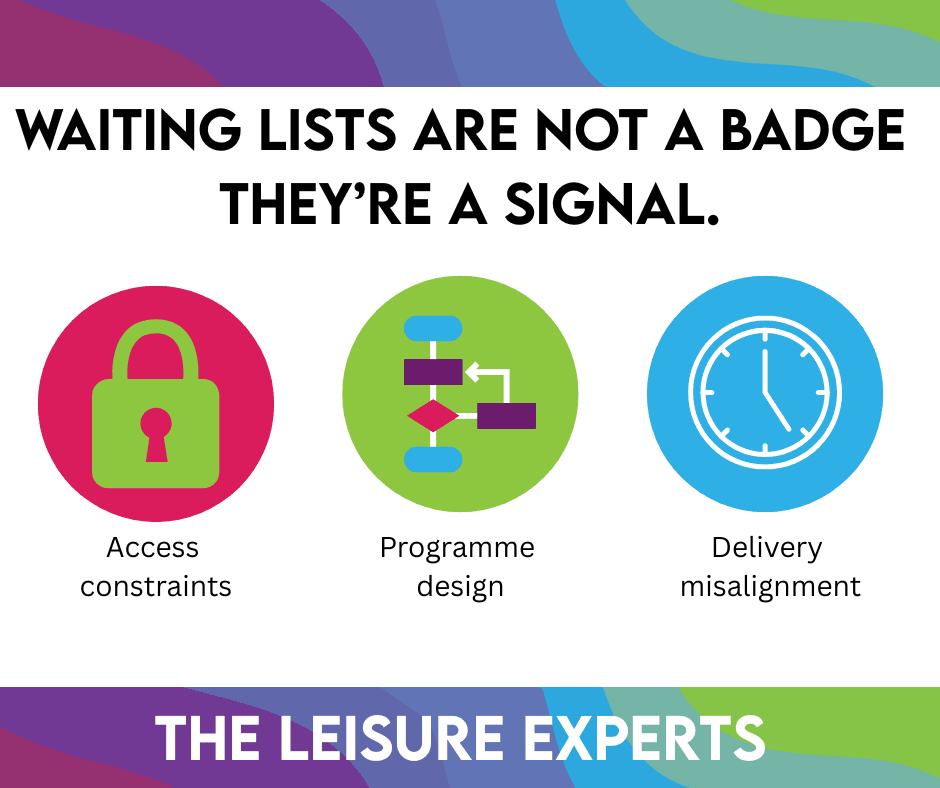
Waiting Lists Are a Signal - Not a Badge
At The Leisure Experts, we see waiting lists as information. Something to be understood, not celebrated or feared.
What a Waiting List Can Mean
Sometimes, waiting lists reflect genuine access constraints.
There may be real limits around water space, workforce availability, operating hours, or funding. In these situations, the right response is not to push harder or squeeze more in, but to design programmes that staff can sustain and communities can rely on.
Doing the right thing matters more than doing the easy thing.
However, in many cases, waiting lists are signalling something different.
Not poor management.
Not lack of effort.
Not teams getting it wrong.
What we usually see are patterns.
Patterns We See Across the Sector
A pattern of programme design shaped by historical need rather than current demand.
A pattern where timetables look full, but utilisation varies significantly across the week.
A pattern where some parts of the programme are oversubscribed, while others remain underused.
In these situations, a waiting list is not evidence that capacity doesn’t exist.
It is often evidence that capacity is unevenly distributed or not yet visible.
This is an important distinction.
Why Framing Matters
When waiting lists are framed as either a success story or a crisis, they tend to close conversations down.
Teams feel pressure.
Leaders feel urgency.
Quick fixes are prioritised over sustainable design.
A more helpful and honest framing is this:
We may be full in some places, and underused in others.
This shift changes the conversation from blame to possibility.
Clarity Creates Options
At TLE, we use data with dignity.
Not to prove anyone wrong, and never to criticise teams working under pressure, but to support calm, evidence-based decision making.
When programmes, water space, staffing models and demand are viewed together, patterns become clear. That clarity creates options: where to protect, where to redesign, and where small changes can unlock meaningful access.
The goal is not to do more at any cost.
The goal is to design services that:
- reflect real constraints
- protect teams
- and meet community need in a sustainable way
Our Approach
We meet organisations where they are.
Within their constraints, we help identify the next right step, not a generic solution, not a one-size-fits-all model.
By naming patterns rather than people, and by focusing on systems rather than symptoms, we help organisations move from “we’re full” to a clearer understanding of what’s really happening.
Curious What Your Waiting List Is Telling You?
If you are seeing waiting lists and are unsure what they truly represent, the answer usually isn’t more pressure.
It’s better visibility.
Programme mapping allows us to see where capacity is genuinely constrained, where it is underused, and where thoughtful redesign could create access without exhausting teams.
If this resonates, and you would like a calm, evidence-led view of your programme, ask us to map it 🙂
Waiting lists are not a verdict.
Handled with care, they are an opportunity to bring clarity and design better from there.


